

When the Forest Disappears, Baboons Move In: Nyagatare Residents Struggle to Coexist with Displaced Wildlife
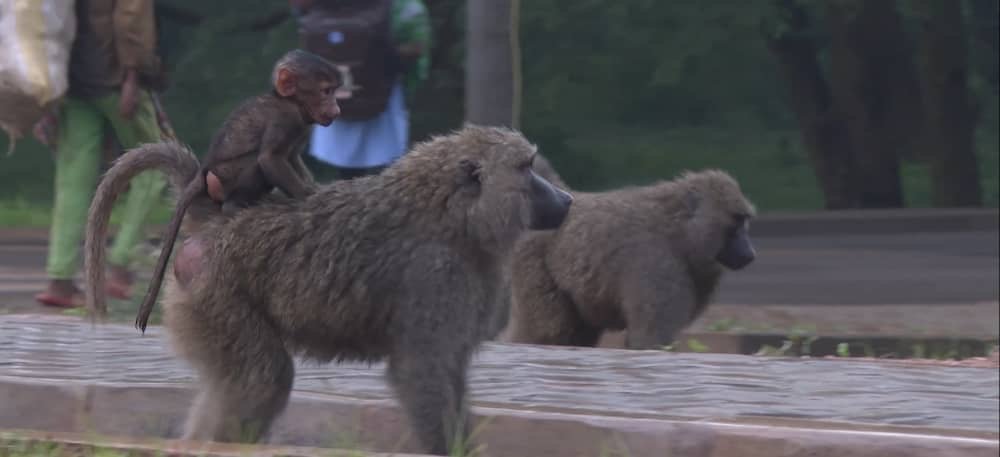
At around 10:30 a.m., an unusual visitor was holding court at the entrance of a small shop on the outskirts of Nyagatare town.
A large baboon, apparently a male, sat comfortably at the doorway, seemingly waiting for customers as though it owned the place. When shoppers arrived, they stopped in their tracks. Some were too frightened to enter and instead turned away.
The shopkeeper, Kalisa Jean Damascène, tried repeatedly to chase the animal away. But the baboon would not budge. It remained seated, seemingly unbothered by his efforts.
Eventually, some customers decided that confrontation was not the answer. They offered it bananas. The animal accepted the unexpected treat, walked a short distance away and settled down to eat. Once it had finished, it casually shook its tail and wandered off.
For Kalisa and other traders in Nyagatare, however, encounters like this are no laughing matter. Baboons have increasingly become a familiar, and often unwelcome, presence in parts of the town, leaving residents worried about their safety, livelihoods and property.
What may appear to be an amusing encounter to an outsider has become a daily struggle for people whose homes and businesses are increasingly sharing space with wildlife.
An uneasy neighbourhood: When baboons become a threat
Residents say the damage caused by baboons goes far beyond occasional visits to shops.
Sibomana Joseph says the animals regularly raid farms, destroy fruit trees, damage rooftops and break into homes in search of food.
“These animals cause enormous damage. They raid our gardens, destroy fruit trees, climb onto rooftops and damage them, and steal food from people’s homes. They are a real nuisance. They should go back where they belong!” he says.
For small-scale traders, the problem is equally distressing.
Uwamahoro Solina, who runs a small business in Nyagatare town, says street vendors are particularly vulnerable. Those selling bananas and maize often find themselves chased away or robbed of their merchandise.
She adds that the animals also frighten women and children, sometimes with serious consequences.
“Recently, a woman was frightened by baboons near Nyagatare District Hospital. She fell into a drainage channel and injured herself,” she recalls.
Behind these encounters lies a deeper question that residents say is often overlooked: why are baboons increasingly finding their way into human settlements?
People familiar with the area’s history trace the problem to the gradual encroachment of human settlements and farming activities into the woodland that once provided the animals with a natural habitat.
They say the conflict began as the woodland came under increasing pressure from people seeking land for homes and cultivation.
In their view, the baboons did not simply abandon their home. Their home was gradually taken over.
Kanyanzira Thomas says the animals have been left with nowhere to go.
“They are now caught in a difficult situation. They have nowhere to live and nowhere to go. Wherever they turn, they are met with shouting and stones as people chase them away. There are even volunteers tasked with preventing them from entering Nyagatare town,” he says.
Displaced from their habitat, with nowhere to turn
Land disputes in Rwanda are commonly associated with disagreements between people. But on the outskirts of Nyagatare, another form of conflict is unfolding: one between humans and wildlife.
The baboons once inhabited the Imikinga woodland, whose area has gradually been reduced by human activities, including farming and settlement expansion. The remaining woodland stretches along the banks of the Umuvumba River.
As their natural habitat has shrunk, the animals have increasingly found themselves living closer to human settlements, creating an uneasy coexistence.
Residents argue that while people have gained access to land that was once part of the animals’ habitat, little has been done to provide the baboons with an alternative place to live.
There has been no compensation for the loss of their habitat, they say, nor a clear plan to relocate them or help them adapt to their changing environment.
For Mutabaruka Emmanuel, the situation raises an uncomfortable question about how people perceive wildlife.
“The baboons did not come from Uganda. They were already living here before we arrived. We are the ones who came, but we have land ownership documents. Does that mean the animals have no rights? We are occupying their land, yet we call them thieves,” he says.
Kabera Edouard shares the same concern. He believes human settlement around the woodland has left the animals exposed, without adequate support to adapt to their new circumstances.
“After people settled near the woodland, these animals found themselves pushed out, with nowhere else to go. No one provided them with assistance to help them cope with the new conditions created by their sudden displacement,” he says.
He argues that the discussion about human-wildlife conflict should also acknowledge the role people have played in creating the problem.
“People talk about baboons invading human settlements, but they rarely talk about humans invading the baboons’ habitat. When the animals return, we chase them away, beat them and throw stones at them. I feel we are the ones who have denied them their right to the land they once occupied,” he says.
Chasing them away is not a lasting solution
The Nyagatare District authorities say more than 30 forest guards have been deployed to chase baboons away whenever they venture into residential areas.
While the initiative is intended to protect residents and prevent the animals from entering town, some community members question whether chasing them away is enough to address the underlying problem.
They fear that repeated confrontations could injure the animals and make them increasingly aggressive.
Semana Thadee, a trader in Gakuba trading centre, near the Imikinga woodland, believes the animals have been left in an impossible situation.
“When someone is displaced from their land, the law provides for compensation. But these animals were also displaced from the land where they lived. They were not compensated, and no alternative home was provided for them. Now they are left in confusion, struggling to survive on land that has been taken over by human settlement,” he says.
Environmental experts warn that keeping wildlife away from human settlements without addressing the loss of its natural habitat may create further challenges for both animals and communities.
Ange Manishimwe, an environmental expert, says measures that rely solely on chasing animals away, without identifying a sustainable solution, could have serious consequences.
“Simply driving them away without finding a lasting solution could create more serious problems,” Manishimwe says.
The challenge, therefore, is not merely to keep baboons out of town, but to find a way for people and wildlife to coexist without putting either at risk.
RDB: Restoring the balance between people and wildlife
To understand the broader causes of the conflict and what is being done to address it, The Bridge Magazine spoke to Ngoga Telesphore, Head of the Conservation Department at the Rwanda Development Board (RDB).
Ngoga explains that changes in land use, particularly when natural areas are converted into farmland or settlements, disrupt the habitats of wildlife and force animals to adjust their behaviour and survival patterns.
“The larger part of the former Mutara region was once a natural ecosystem inhabited by wildlife. As the area developed, one of the consequences was that some animal species, including baboons, found themselves in places that were no longer their natural habitats. They increasingly had to live alongside people,” he says.
He stresses that addressing human-wildlife conflict requires cooperation between local communities, government institutions and conservation organisations.
“Measures to address problems caused by baboons, just like those involving other wildlife, will only be effective if communities work together with the relevant institutions and other stakeholders,” he explains.
Ngoga says a programme involving young volunteers has been introduced to help drive baboons away from the town and prevent them from entering Nyagatare’s residential areas.
The initiative brings together RDB, Nyagatare District authorities and other partners, including the Rwanda Environment Management Authority (REMA) and the Rwanda Wildlife Conservation Association (RWCA).
He also points to plans to rehabilitate the Umuvumba Valley and develop it into an area that can support and conserve wildlife.
“We are optimistic that this project will provide a lasting solution,” he says.
Asked about residents’ concerns that the baboons have been displaced without compensation or alternative arrangements, Ngoga says land-use planning must take into account both human welfare and biodiversity conservation.
“As the population grows while the amount of available land remains limited, land use must be carefully considered, with attention also given to the needs of future generations,” he says.
He adds that development should not come at the expense of the natural ecosystems that support human life.
“In addressing this problem, we must not overlook biodiversity, including wildlife. It plays an important role in human life. That is why we are working to find ways for people to coexist peacefully with other components of the ecosystem,” he explains.
What happens when baboons damage property or injure people?
Beyond the broader conservation debate, residents also want to know what happens when encounters with baboons result in injuries or property damage.
Ngoga says compensation mechanisms are available to people affected by wildlife.
“Residents who suffer harm caused by baboons are entitled to compensation in accordance with the law. Procedures have been established for claiming compensation, and the Government has put in place a relief fund to provide such payments,” he says.
He explains that affected residents should report incidents through their local administrative authorities, who help prepare reports documenting the damage and losses for which compensation is sought.
However, preventing future incidents also requires communities to understand wildlife behaviour and take precautions.
Ngoga advises people living in areas inhabited by baboons to avoid leaving doors open, keep waste properly managed and refrain from leaving food or rubbish exposed, as these can attract the animals.
He also emphasises the importance of managing wildlife populations in human-occupied areas and promoting initiatives that can generate economic benefits from wildlife, rather than allowing it to remain a source of conflict.
About Author