
Nyabihu Farmers turn to organic manure to build climate resilient agriculture
Organic manure is one of the practical solutions that can help farmers cope with the effects of climate change by improving soil fertility, increasing the soil’s ability to retain water, and reducing soil erosion.
Farmers in Nyabihu District say using organic manure has helped them protect their farmland and ensure that crops retain the moisture they need, particularly during dry periods.
In Kintobo Sector, Nyabihu District, some farmers are using organic manure to improve soil conditions and increase agricultural productivity.
Nyiramigisha Jeanine, a farmer in Kintobo Sector, says using organic manure has helped her conserve soil moisture, particularly during prolonged dry spells when the soil would otherwise dry out quickly.
“Previously, when the dry season lasted for a long time, the soil would become very dry, leaving crops without enough moisture. However, after using organic manure, I noticed that the soil retains moisture for longer, helping crops continue growing even when rainfall decreases,” she says.
Another farmer, Kagiraneza Jean Claude, also from Kintobo Sector, says organic manure has helped reduce soil erosion caused by rainwater while improving soil fertility.
“When heavy rains fell, water would flow over the surface of the soil, sometimes carrying away the fertile topsoil. Since I started using organic manure, I have noticed that the soil retains more water and maintains its fertility. This helps me cope with the effects of climate change and sustain my farming activities,” he says.
How organic manure helps protect soil
Organic manure improves the soil’s capacity to absorb and retain water, preventing it from drying out quickly during dry periods. This helps reduce the effects of drought and protects farmland against soil erosion.
Nteziryayo Ignace, an agricultural expert, explains that soil enriched with sufficient organic matter can retain more water than soil with little or no organic matter.
When rainfall occurs, water can infiltrate the soil rather than flowing across its surface. This reduces soil erosion and increases the amount of water stored in the soil.
As a result, crops can access the moisture they need to grow, particularly during dry periods. The use of organic manure is therefore one of the approaches that can help farmers adapt to the effects of climate change and build more resilient agricultural systems.
How organic manure is prepared
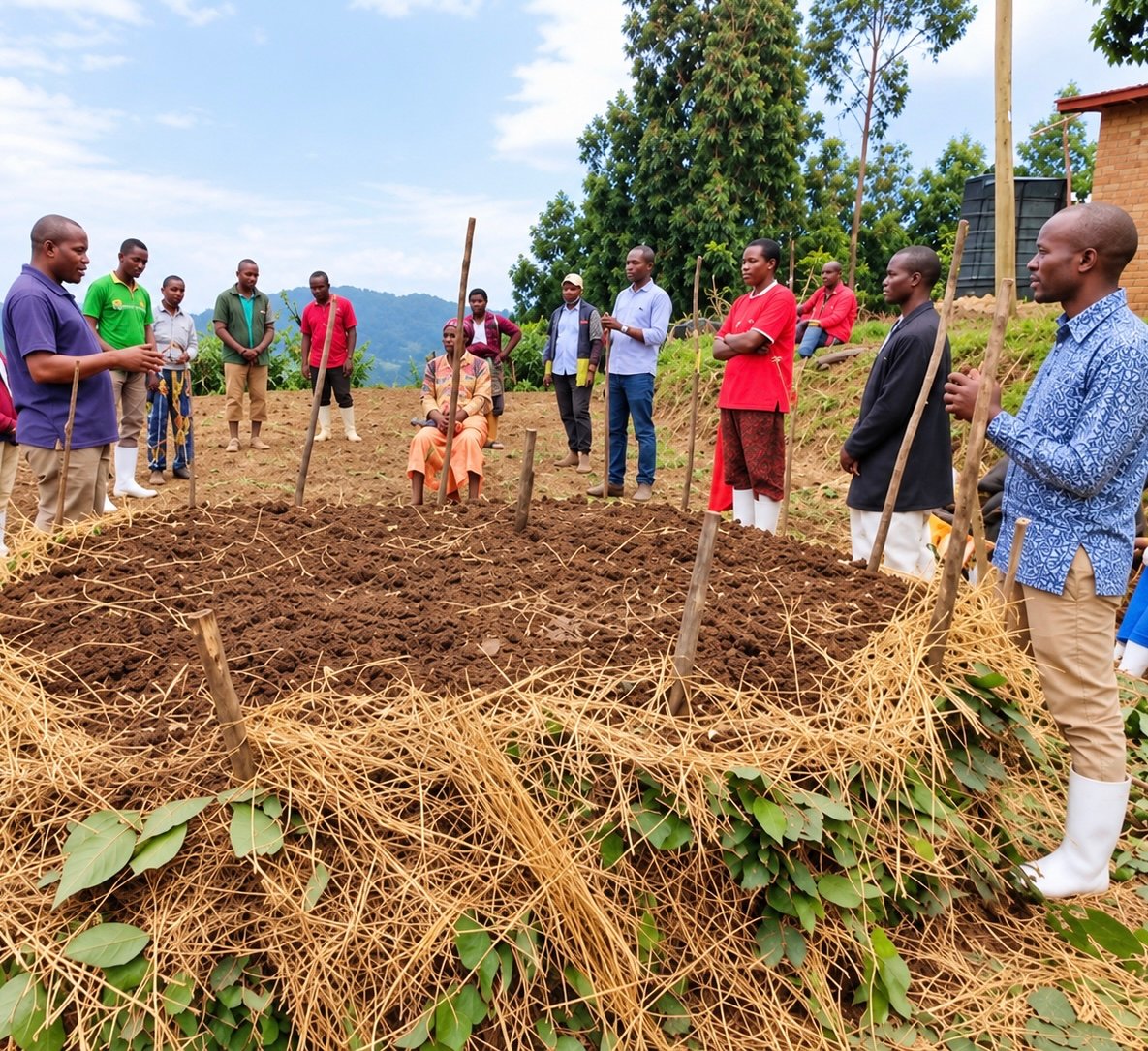
Nteziryayo Ignace explains that preparing organic manure begins with selecting and preparing a space measuring approximately one metre by one metre. Small branches are first placed at the bottom of the heap to allow air to circulate through the materials.
He explains: “First, you prepare a space measuring one metre by one metre for the compost heap. You then place small branches at the bottom to allow air to circulate beneath the grass and ensure that the organisms involved in decomposition have access to air and light.”
After preparing the base, chopped grass measuring approximately 20 centimetres is added and sprinkled with water to moisten it. A layer of organic manure or fertile soil is then added to facilitate the decomposition of plant materials, including crop residues, leaves, stalks, vegetable waste, fruit peels, grass and other biodegradable materials.
A stick is placed vertically in the middle of the heap to help air circulate through it. Green grass is then added on top, followed by ash and lime to help reduce acidity that may develop during decomposition. These layers are repeated until the heap is complete.
According to Nteziryayo, a compost heap measuring one metre by one metre can produce approximately one tonne of organic manure, depending on the materials used.
How long does organic manure take to decompose?
For the compost heap to decompose properly, it requires regular maintenance throughout the process.
During dry periods, the heap should be watered to maintain the moisture needed for decomposition. Animal dung or urine can also be added to accelerate the process.
After two months, the heap should be turned over so that the materials initially placed on top are moved to the bottom, allowing all the materials to decompose evenly.
Depending on the temperature of the surrounding area and the type of materials used, the organic manure can be ready for use within four to six months.
Making and using organic manure is one of the sustainable approaches to protecting soil, improving soil fertility and helping farmers cope with the effects of climate change.
About Author